
May 28, 2026 - PBS News Hour full episode
5/28/2026 | 57m 46sVideo has Closed Captions
May 28, 2026 - PBS News Hour full episode
May 28, 2026 - PBS News Hour full episode
Problems playing video? | Closed Captioning Feedback
Problems playing video? | Closed Captioning Feedback
Major corporate funding for the PBS News Hour is provided by BDO, BNSF, Consumer Cellular, American Cruise Lines, and Raymond James. Funding for the PBS NewsHour Weekend is provided by...
May 28, 2026 - PBS News Hour full episode
5/28/2026 | 57m 46sVideo has Closed Captions
May 28, 2026 - PBS News Hour full episode
Problems playing video? | Closed Captioning Feedback
How to Watch PBS News Hour
PBS News Hour is available to stream on pbs.org and the free PBS App, available on iPhone, Apple TV, Android TV, Android smartphones, Amazon Fire TV, Amazon Fire Tablet, Roku, Samsung Smart TV, LG TV, and Vizio.
Providing Support for PBS.org
Learn Moreabout PBS online sponsorshipGEOFF BENNETT: Good evening.
I'm Geoff Bennett.
Amna Nawaz is away.
On the "NewsHour" tonight: The U.S.
and Iran close in on a tentative deal to extend the cease-fire.
We report from the Strait of Hormuz for an up-close look at the world's most embattled waterway.
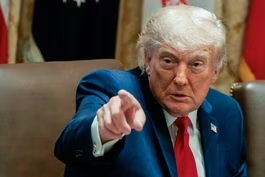
Stock trading tied to Donald Trump fuels accusations of corruption and profiting off the presidency.
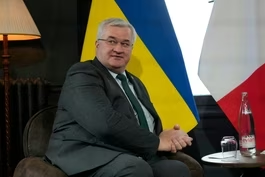
And Ukraine's foreign minister highlights his country's rapidly advancing drone capabilities, how it could reshape the war with Russia.
ANDRIY SYBIHA, Ukrainian Foreign Minister (through translator): We proved how effective it could be in Russia.
There are no safe places.
We could attack them at a distance up to 2,000 kilometers.
(BREAK) GEOFF BENNETT: Welcome to the "News Hour."
Tonight, Vice President J.D.
Vance said the U.S.
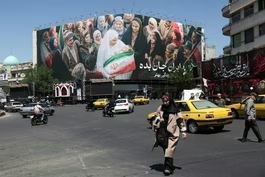
and Iran have made what he calls a lot of progress in their talks to end the war, but that it wasn't clear when or if President Trump was going to sign off.
Those comments come after a White House official told the "News Hour" and other outlets that U.S.
and Iranian negotiators had agreed to a framework.
Iran today said no agreement had been made, while Iran fired a ballistic missile at Kuwait and as the U.S.
and Iranian militaries again traded fire.
Nick Schifrin is tracking all of this for us.
So, Nick, let's start with this talk about a deal.
What at this point is President Trump demanding?
NICK SCHIFRIN: Well, before we get to what he's demanding exactly, because it's going back and forth, I think let's examine these conflicting statements that we have got.
The White House told me earlier today that, yes, there was a deal between the U.S.
and Iran.
They agreed on a 60-day cease-fire in order to basically open the Strait of Hormuz and kick-start nuclear negotiations.
But, as you said, the vice president tonight not saying that.
He not only said what you mentioned that it's not clear when or if the president was going to sign, but he added: "That requires us to make a little bit more progress, and I can't guarantee that we're going to get there."
So that is not the same at all as what the White House was saying earlier today, that there wasn't a deal.
But, regardless of all the posturing, perhaps, the core of your question is, what are we looking at?
What kind of deal are we looking at?
What is the president holding out for?
European, U.S.
and Arab officials all confirm that this is the deal on the table.
It's a two-phase deal.
The first phase would open up the Strait of Hormuz, including no tolls, and the U.S.
would end its blockade.
The war would end, including in Lebanon.
And then there are in-principle agreements that Iran would limit its nuclear program and the U.S.
would lift sanctions.
And that brings us to the second phase.
Iran would freeze uranium enrichment, uranium enrichment for TBD years.
U.S.
and Iranian officials tell me the U.S.
is pushing for 20 years.
Iran has offered five to 10 years.
Number two, Iran would export or destroy its 1,000 pounds of highly enriched uranium.
The president recently softened his position on that.
And, thirdly, the core of the U.S.
offer, lifting sanctions and unfreezing assets.
Earlier this week, a senior administration official put it this way, "No dust, no dollars," as in, if there's no highly enriched uranium export, Iran gets nothing.
So what the officials around the president are really emphasizing is that, until Iran agrees on highly enriched uranium and really limiting its nuclear program, there is no deal.
And so that's where we think the rub is tonight.
And that's what Scott Bessent said, that there will be no deal until Iran agrees to what the president's demanding.
SCOTT BESSENT, U.S.
Treasury Secretary: Nothing is going to be on the table until we see the Strait of Hormuz open and the Iranians agree that they have to turn over the highly enriched uranium and that they can't have a nuclear program.
NICK SCHIFRIN: So, despite the apparent progress, Geoff, Iran has still not publicly confirmed that it's willing to restrict its nuclear program in any way.
And a reminder, U.S.
and Iranian officials say that this would not restrict in any way Iran's ballistic missile program, or at least in writing its support for proxies.
GEOFF BENNETT: And there is still military activity between the U.S.
and Iran.
What happened today?
NICK SCHIFRIN: Today, U.S.
and Kuwait said that Iran had fired drones and at least one ballistic missile at Kuwait.
A U.S.
official told me it was intercepted, but -- quote -- "fragments of the interception" did make impact.
The official said there was no one seriously injured.
The U.S.
military called it a dangerous, egregious violation of the cease-fire.
It also said that it intercepted five Iranian attack drones.
This follows another exchange of fire on Monday.
Now, Iran hasn't confirmed any of these details, but it did release this video today, posting posters on a missile and firing a missile.
And, today, Iran's deputy foreign minister blamed the U.S.
for violating the cease-fire.
KAZEM GHARIBABADI, Iranian Deputy Foreign Minister (through translator): What the United States did was meant with a decisive response from the armed forces and the Islamic Revolutionary Guard Corps.
And it was certainly a violation of the cease-fire.
And Iran will respond to any violation of the cease-fire.
NICK SCHIFRIN: So, bottom line, Geoff, where we are tonight, U.S.
and Iran bickering over what's happening, disputing statements by - - within the U.S.
of how far progress is, but all sides saying there is progress.
There's clearly no deal yet.
GEOFF BENNETT: All right, Nick Schifrin, our thanks to you, as always.
NICK SCHIFRIN: Thank you.
GEOFF BENNETT: Well, the Strait of Hormuz has been the focus of this war since Iran churned it down in the war's first days, but rarely do American reporters actually get to visit this crucial body of water.
So, tonight, we have this rare look at the Strait of Hormuz from the land and on the water from special correspondent Reza Sayah, who was based in Iran.
REZA SAYAH: All right, here we are, the Strait of Hormuz.
By the way, that's the correct pronunciation.
It's Hormuz, not Hormuz.
This is the waterway that's made headlines over the past three months, the focal point of the conflict between Washington and Tehran, the waterway that's squeezed the global economy, the U.S.
economy, and likely caused you to pay more of the gas pump.
Iranian authorities have granted us permission to come here and look around.
There's no one accompanying us.
We have our cameraman, Castro (ph), behind the lens, Captain Audamid (ph).
And we're going to look around here and show you what it looks like these days in the Strait of Hormuz.
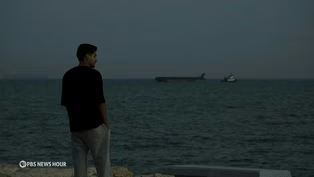
In all directions here, we see the impact of the conflict between Washington and Tehran, ship after ship stuck, sitting and waiting, the outcome of a three-month-long Iranian blockade of any commercial ship with links to what Tehran deems hostile nations.
Last month, Washington answered with its own naval blockade of ships traveling to and from Iranian ports.
The United Nations says the competing blockades have stranded roughly 1,500 ships with more than 20,000 seafarers on board.
Most of the international ships are anchored west of the strait, deep inside the Persian Gulf.
Closer to the strait, we see mostly Iranian ships.
All right, this looks like an Iranian oil tanker.
It has an Iranian flag.
It says Qeshm (ph) on the hull, which is the name of a nearby island here in Iran.
It is quite possible that this is one of the Iranian vessels being blocked in by the U.S.
naval blockade.
We're going to see if we can talk to someone on board, see what they're carrying and how long they have been here.
(SPEAKING IN FOREIGN LANGUAGE) MAN: (SPEAKING IN FOREIGN LANGUAGE) REZA SAYAH: I asked them how long they have been anchored here, and they say they're not allowed to talk.
(SPEAKING IN FOREIGN LANGUAGE) MAN: (SPEAKING IN FOREIGN LANGUAGE) REZA SAYAH: I asked them what their cargo is.
Again, they're not allowed to talk.
The narrowest section of the strait is about 24 miles wide, seemingly plenty of room for ships to pass through, but the waters here are shallow, with an average depth of 165 feet.
That's less than half of a football field.
The United Nations has recognized a traffic separation scheme for large ships with an inbound and outbound lane, each less than two miles wide.
Washington says international vessels are guaranteed the right of transit passage.
Tehran says these are their territorial waters, authority belongs to them and Oman, whose coast borders the southern part of the strait.
In the face-off over the strait and its blockade, both Iranian and U.S.
forces have clashed, most recently this week.
On Monday, the Pentagon said U.S.
jet fighters hit and destroyed a couple of IRGC speedboats in the Strait of Hormuz.
These are the speedboats Iranian forces use to block some of these vessels from exiting the strait.
Behind me, and it's very difficult to see in the distance, is Larak Island.
Many locals here say it is very likely that the Revolutionary Guard speedboats that were hit were somewhere around that island.
Out of all the islands here, Larak sits deepest within the strait.
Iranian state media on Tuesday reported that a number of their Revolutionary Guard officers were martyred, but they didn't provide any other details.
One of more than a dozen islands that sit at or near the strait is Hormuz Island.
Around 6,000 people live in this tiny resort destination that puts in view Iran's diversity.
Along the beach, chic cafes serve the island's bohemian lifestyle.
A few blocks away, the island's conservative population holds their nightly rally in support of Iran's war with the United States and Israel.
This is where we learned that three of the Revolutionary Guard members killed on Monday were from this island.
Ismael Hormuz says the island is small.
Many knew the officers killed.
ISMAEL HORMUZ, Hormuz Island Resident (through translator): They were my friends.
They were my family, my brothers, my friends.
Just a few days ago, we were chanting slogans together.
We were spending time together.
Hormuz is an island where we all know one another.
We're one.
Their bodies have still not been recovered.
The remains have yet to be returned to their families.
And they want us to sit at the negotiating table?
No way.
REZA SAYAH: Mohammad Reza Nik says he knew the officers too.
He says they gave their lives for Iran.
Many here are willing to do the same.
MOHAMMAD REZA NIK, Hormuz Island Resident (through translator): Is the color of my blood different than theirs?
It's not.
We can all have the honor of martyrdom.
Is my blood different from the supreme leader's blood?
This is our duty.
Whatever we have comes from this soil, from this country.
REZA SAYAH: Defending their country is their duty, many here say.
And that includes defending the Strait of Hormuz, which remains a major flash point in the conflict between Washington and Tehran.
For the "PBS News Hour," I'm Reza Sayah in the Strait of Hormuz, Iran.
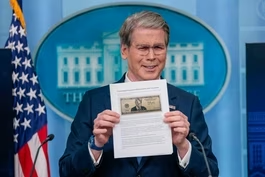
GEOFF BENNETT: In the day's other headlines, officials at the Treasury Department are laying the groundwork for a new $250 bill featuring President Trump's image.
A mockup was first obtained by The Washington Post.
It's meant to commemorate the nation's 250th anniversary and would be the first time a living person is featured on American currency in more than 150 years.
But its fate ultimately rests with Congress, where legislation has stalled that would overturn a federal law prohibiting living Americans from appearing on U.S.
currency.
At today's White House press briefing, Treasury Secretary Scott Bessent said the $250 bills would be ready for circulation should the legislation pass.
SCOTT BESSENT, U.S.
Treasury Secretary: At present, no living person can be on U.S.
currency.
At Treasury, we prepare things in advance, so we have prepared in advance that -- if the legislation is passed, but we will stick to the law.
GEOFF BENNETT: Congress outlawed images of living people back in 1866 after a Treasury official printed his own likeness on a 5 cent note, leading to widespread outrage at the time.
A federal judge in Washington is refusing to block President Trump's executive order limiting mail-in voting, at least for now.
The order was issued back in March and would also direct the creation of a federal voter list.
In his 26-page opinion, Judge Carl Nichols a Trump appointee, wrote that it was too soon for the court to intervene since the Trump administration hasn't implemented much of the order yet.
Democrats and civil rights groups have argued that the move exceeds the president's authority since the Constitution gives the power to set election rules to Congress and the states.
The Justice Department has reportedly opened an investigation into former columnist E. Jean Carroll, who won multiple civil cases against President Trump on accusations of sexual abuse and defamation.
The Associated Press and other outlets say the DOJ is looking into whether Carroll lied during the course of the litigation.
She accused Mr.
Trump of forcing himself upon her in a dressing room in the 1990s, which he denies.
It is the latest example of the DOJ taking action against one of President Trump's perceived enemies.
In Central Africa, international aid is making its way to areas most affected by a growing Ebola outbreak.
These supplies were donated by the European Union and they come as health workers have reported being poorly prepared to tackle the fast-spreading disease.
The Democratic Republic of the Congo has been hardest hit, with more than 1,000 suspected cases and 220 suspected deaths.
Meantime, senior Trump administration officials confirmed today that the U.S.
will open a 50-bed Ebola quarantine center in Kenya tomorrow.
It's meant exclusively for Americans, though, which is frustrating some locals.
SERAH NJOROGE, Nairobi, Kenya, Resident: Why would you create a facility in my country and it doesn't serve me?
Yet, the same -- same facility is going to host people who are endangering my own life.
Yet, if I end up contacting Ebola, God forbid, I can't be taken care of.
GEOFF BENNETT: Also today, the U.S.
State Department announced it's sending $80 million in aid to affected countries.
The money is meant to help with protective equipment, as well as screening and testing for the virus.
Major League Baseball owners proposed a salary cap for the first time in decades today, something the players union has vowed to never accept.
Under the proposal, teams would need to maintain a payroll of at least $171.2 million and couldn't exceed $245.3 million.
Eight teams currently spend more than that, including the World Series champion L.A.
Dodgers.
If the two sides can't reach a deal before the current contract expires in December, owners could lock out the players.
The last time that happened was back in 1994, and it led to a seven-month strike that canceled the World Series.
On Wall Street today, stocks climbed to new records after the latest round of strong corporate earnings.
The Dow Jones industrial average added about 25 points on the day.
The Nasdaq jumped nearly 250 points, or almost 1 percent.
The S&P 500 also posted a solid gain.
Still to come on the "News Hour": a Palestinian woman detained for a year after protesting the war in Gaza speaks out about her experience; a push to rename a common hormonal condition aims to improve care for millions of women; and as the World Cup approaches, we look at the decades-long effort to improve the U.S.
men's national soccer team.
Earlier this month, President Donald Trump disclosed that his trust is actively trading individual stocks, an unprecedented practice for a sitting U.S.
president in the modern era.
The arrangement is raising new questions about whether the president's actions, policies, or public statements could directly benefit his personal financial holdings.
Our White House correspondent, Liz Landers, takes a closer look.
LIZ LANDERS: It would be hard to find a president in recent history who has spoken publicly about the stock market more than Donald Trump.
DONALD TRUMP, President of the United States: I just turned on the television and wanted to see how the stock market is doing today.
We hit 50000 on the Dow.
We hit 7000 on the S&P.
Our stock market is now at the highest point in history.
LIZ LANDERS: And perhaps it's not all that surprising.
Donald Trump has built a multibillion-dollar personal brand, and he is one of the only people to go directly from the boardroom to the White House without holding any other elected office.
DONALD TRUMP: Look at the numbers.
Look at the stock market.
LIZ LANDERS: It's one thing to watch the market, but it's another thing altogether to actively trade stocks while in office.
Mr.
Trump's most recent federal financial disclosure form, filed earlier this month, reveals more than 3,700 trades in the first three months of this year, a flurry amounting to tens of millions of dollars in transactions.
The disclosure filing, called a Form 278, is required of senior government officials by the U.S.
Office of Government Ethics within 45 days of any financial trade.
It doesn't list specific amounts, only broad value ranges, and it's designated to ensure some level of transparency.
DAN ALEXANDER, Senior Editor, "Forbes": The fact that he not only owns stocks, but is actively trading them, there's just no precedent in recent history.
LIZ LANDERS: Dan Alexander is a senior editor of Forbes magazine and the author of "White House, Inc.
: How Donald Trump Turned the Presidency into a Business."
DAN ALEXANDER: The key question here is, are those holdings impacting the decisions that he's making?
And what's tricky about this, like so many other things, is that, in order to answer that question, you really have to get inside Donald Trump's head.
LIZ LANDERS: In a statement to "PBS News Hour," the Trump Organization said -- quote -- "President Trump's investment holdings are maintained exclusively in fully discretionary accounts managed by independent third-party financial institutions.
"These institutions have sole and exclusive authority over all investment decisions, including asset allocation, trading, rebalancing, and portfolio management.
Investments are executed and allocated through automated model-based portfolios and direct indexing strategies administered entirely by those firms."
On the morning of March 23, after nearly a month of war with Iran, the president announced on TRUTH Social that the U.S.
and Iran had been having -- quote -- "very good and productive conversations" and that he was extending his deadline for a deal by five more days.
Oil prices plunged nearly 11 percent on hopes the war was ending, energy stocks sold off, and the brokerage account in Trump's name spent the day buying them, Phillips 66, ExxonMobil, Chevron, along with defense and aerospace names like Lockheed Martin and General Dynamics, all companies that stood to profit the longer the war continued.
Is it illegal for a president to own positions within the stock market, to own individual stocks?
RICHARD PAINTER, Former Associate Counsel to President George W. Bush: Unfortunately, the financial conflict of interest statute does not apply to the president, the vice president, and members of Congress.
LIZ LANDERS: Richard Painter was the chief White House ethics lawyer for President George W. Bush.
He says the power of the president to affect the market is profound and should be more tightly restricted.
RICHARD PAINTER: If, through his official actions, he actually can change the price of the stock, and he owns the stock, that's a financial conflict of interest that should be prohibited.
DONALD TRUMP: Let's also ensured that members of Congress cannot correctly profit from using insider information.
(CHEERING) LIZ LANDERS: In the State of the Union this year, President Trump threw his support behind efforts to ban stock trading by members of Congress.
But what he didn't say is that there's no such ban for presidents, and he didn't call for one.
RICHARD PAINTER: A treasury secretary who owns bank stock, a defense secretary who owns stock in defense contractors would commit a felony if they participated in decisions that affected those investments.
And this is why every official in the United States government is required to divest.
LIZ LANDERS: Every president since Ronald Reagan has either put their assets in a blind trust managed by independent trustees or sold off their stocks to eliminate conflicts of interest.
While President Trump did transfer his assets into a trust, it is not blind, says Dan Alexander.
DAN ALEXANDER: The trust doesn't hand over the ownership of those assets to anybody else.
It allows his kids to make decisions about them on a day-to-day basis.
Those assets are still owned by Donald Trump, so, therefore, all the potential conflicts with them and all the money that comes with them still rolls back to Donald Trump.
QUESTION: Do you have any regrets about your presidency?
LIZ LANDERS: Alexander says Trump's wealth has grown exponentially since he first left office in 2021.
DAN ALEXANDER: When he left office, we estimate that he was worth $2.4 billion.
We now estimate that he's worth $6.1 billion.
A lot of that is an increase in liquid assets, principally through his crypto ventures that have brought in a lot of money.
LIZ LANDERS: In 2025, Mr.
Trump's accounts traded almost exclusively in municipal and corporate bonds, which didn't raise conflict of interest concerns.
But that changed in January this year, when Mr.
Trump's accounts started to actively trade individual stocks, and some of the companies have ongoing direct involvement with the federal government.
Take Palantir Technologies.
It has billions of dollars in contracts with the Trump administration, including a $1.3 billion contract with the Pentagon to develop A.I.
systems to help orchestrate military operations.
Since January, Mr.
Trump's account has made nine purchases of Palantir stock worth up to $680,000.
When the stock declined nearly 15 percent in early April, Trump posted on TRUTH Social -- quote - - "Palantir Technologies has proven to have great war-fighting capabilities and equipment.
Just ask our enemies."
Within 10 days, the stock had more than regained its value.
MAN: Nvidia's next generation of A.I.
chips is in full production.
LIZ LANDERS: In early January, the president's account purchased between $500,000 to $1 million worth of Nvidia stock.
A week before, Commerce officials approved the sale of some Nvidia chips to China.
In February, he purchased between $1 million and $5 million more just days before Nvidia announced a major computer processing power deal with Meta.
Vice President J.D.
Vance defended the trading in the president's portfolio.
J.D.
VANCE, Vice President of the United States: Number one, the president doesn't sit at the Oval Office on his computer on his, like, Robinhood account buying and selling stocks.
That's absurd.
He has independent wealth of advisers who manage his money.
He is a wealthy person.
He has had success in business.
He's not making these stock trades himself.
LIZ LANDERS: The Trump Organization says -- quote -- "Neither President Trump, his family, nor the Trump Organization has any role in selecting, directing, approving, influencing, or soliciting specific investments.
They receive no advance notice of trades, cannot alter or override the managers' strategies or models, and provide no input regarding investment decisions or portfolio operations."
The structure, the Trump Organization says, is to avoid even the appearance of a conflict of interest.
But Richard Painter says it's difficult to separate the president from his portfolio.
RICHARD PAINTER: It doesn't matter who's making the trades.
The president knows what's in his account.
It's right there on the Form 278.
He knows what he owns.
LIZ LANDERS: And Painter says the bigger issue is the erosion of public trust.
RICHARD PAINTER: The public is not going to have confidence in the securities markets if we have people with access to United States government information actively trading in the markets at the same time as other investors who don't have that information.
LIZ LANDERS: When it comes to presidential trades, perception matters.
For the "PBS News Hour," I'm Liz Landers.
GEOFF BENNETT: With the war in Ukraine now well into its fourth year, Russian President Vladimir Putin has intensified attacks across the country.
But even amid the barrage, Ukraine says it's adapting, pushing back along parts of the front and carrying out increasingly sophisticated drone strikes deep inside Russia.
Special correspondent Simon Ostrovsky sat down with Ukraine's foreign minister to discuss the state of the war and the battlefield lessons Ukraine says are reshaping modern combat.
SIMON OSTROVSKY: As Russia falters on the Ukrainian battlefield, Moscow has attempted to rattle nerves in Ukraine with threats to renew attacks against the capital, including a warning to Washington to evacuate its diplomats from Kyiv.
Meanwhile, Ukraine has continued its campaign of long-distance strikes on Russian energy facilities, describing them as long-range sanctions designed to cripple Moscow's main source of revenue.
In an exclusive interview with "News Hour," Ukraine's Foreign Minister Andriy Sybiha had a warning for Russians, saying they were no longer safe anywhere in their vast country because of Ukraine's improved drone range and capabilities.
ANDRIY SYBIHA, Ukrainian Foreign Minister (through translator): We proved how effective we could be.
In Russia, there are no safe place.
We could attack them at a distance of up to 2,000 kilometers.
Even to conduct this so-called parade, Putin had to approach to allow to conduct this parade on the 9th of May.
SIMON OSTROVSKY: And Donald Trump put pressure, I think, on your country not to attack Moscow during the parade.
ANDRIY SYBIHA: We are not talking about any kind of pressure.
We have great cooperation with our American friends and we are thankful for their efforts.
Without the United States, it is not realistic to achieve tangible results in our peace efforts.
SIMON OSTROVSKY: Sybiha is keen to downplay any tensions with the United States, which he said Ukraine still relies on for air defense weapons, such as Patriot missiles, and intelligence on Russian targets.
ANDRIY SYBIHA: We are buying this type of weaponry from the United States, no delay, by the way, with the supply, despite the situation in the Middle East.
We have such an advantage that we could test our products immediately on the battlefield.
What does it mean?
It means highest quality.
It also means immediate feedback.
SIMON OSTROVSKY: Well we heard our president say that he didn't need any help from Ukraine.
Yet, recently, hasn't there been an agreement between your military and America's military?
ANDRIY SYBIHA: We have a pragmatic cooperation with our American allies.
We are ready to share with our experience, with our technologies.
Our position is clear.
We are open for this type of cooperation.
SIMON OSTROVSKY: But has an agreement been signed, a new agreement on defense technology cooperation?
ANDRIY SYBIHA: Not yet, but we are ready to propose.
And I am confident it will be our true contribution in American security.
We have now this experience, which is also needed for such great countries as the United States.
SIMON OSTROVSKY: We have seen reporting about the fact that the United States may have had to abandon a lot of its military positions in the Persian Gulf because of an inability to defend those bases against drone attacks from Iran.
Ukraine has a wealth of experience with interceptor drones, which are cheap.
And I think that's the sort of cooperation that you're talking about, and you're willing to share that with the United States.
ANDRIY SYBIHA: Absolutely.
And we already proposed to the Middle East countries our expertise.
Now we are a security partner for them.
And for us, this is also important.
SIMON OSTROVSKY: So is Ukraine selling interceptor drones to partners in the Middle East?
ANDRIY SYBIHA: This approach is not about selling, just selling a drone.
SIMON OSTROVSKY: Not just selling, but you are transferring equipment?
ANDRIY SYBIHA: We are talking about long-term arrangements, agreements.
SIMON OSTROVSKY: Do you feel you can still trust the United States and the White House in the way that Ukrainians once did?
ANDRIY SYBIHA: Our security and the security of the United States, the transatlantic security, they are indivisible.
Everything is interlinked.
And I think that strong Ukraine is also a national interest of the United States.
SIMON OSTROVSKY: Europeans talk about Ukraine less frequently as a case for assistance, and more frequently as an example of a military to follow.
Have you noticed a change in the way other countries look at Ukraine?
ANDRIY SYBIHA: Yes, definitely.
We became a security provider, security partner.
Our European allies now need Ukraine.
Ukraine, with its defense capacities, is an essential part of transatlantic security, and it is a smart approach to keep us in.
SIMON OSTROVSKY: Do you see Ukraine joining NATO and the European Union in the near future?
ANDRIY SYBIHA: Definitely.
Ukraine must and will become the member of E.U.
After the Hungarian elections, probably, we eliminated the most difficult political obstacle.
SIMON OSTROVSKY: Orban.
ANDRIY SYBIHA: Regime Orban.
So, yes, true, now we have the chance to speed up our efforts to become a full member of E.U.
SIMON OSTROVSKY: Prime Minister Viktor Orban's defeat in last month's election in Hungary cleared the last remaining barrier for Ukraine's E.U.
ascension negotiations.
ANDRIY SYBIHA: The most important now to end this war.
Ukraine wants to end this war.
We have doable proposals.
We are in the momentum to use our leverage to pressure Russia, not to ease sanctions, but, on contrary, to increase pressure on Russia and to raise the price of further aggression personally for Putin.
He must admit that he will never achieve his goals on the battlefield.
SIMON OSTROVSKY: Yesterday, the new head of British intelligence said more than half-a-million of Putin's troops have been killed in Ukraine since he invaded 4.5 years ago.
And with Ukrainian forces gaining back land in the east, Putin's goals on the battlefield seem further than ever from his grasp.
For the "PBS News Hour," I'm Simon Ostrovsky in Kyiv.
GEOFF BENNETT: In 2024, massive pro-Palestinian protests swept college campuses across the country, including at Columbia University.
As the Trump administration intensified its immigration enforcement and deportation efforts, several noncitizen student protesters were taken into ICE detention.
One of them was detained for more than a year.
Lisa Desjardins has more.
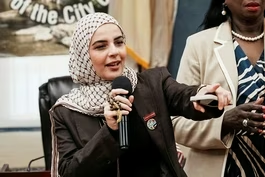
LISA DESJARDINS: Leqaa Kordia arrived in the United States in 2016 on a tourist visa from the West Bank to reunite with her mother, a U.S.
citizen living in New Jersey.
She enrolled in English school, started working as a waitress and applied for her green card in 2017 through a family petition.
But that application did not give her a legal status to stay in the country, and she says she unknowingly became undocumented.
In 2024, Kordia participated in the pro-Palestinian protests at Columbia University.
She was arrested and not charged.
Then she was detained by Immigration and Customs Enforcement nearly a year later.
She was in detention in Alvarado, Texas, from last spring until this March, as immigration courts decide her fate.
Leqaa and her lawyer, Sarah Sherman-Stokes, join us both now.
Thanks to both of you.
Leqaa, you came here 10 years ago.
Your visa ran out in 2022.
But I want to start with your hopes.
You hope to get a green card.
Tell us, first of all, why do you want to become a U.S.
citizen?
LEQAA KORDIA, Detained By U.S.
Immigration and Customs Enforcement: Well, I ran out of -- from a country that's under occupation.
I grew up under fear all the time.
I grew up separated from my own mother all these years.
I always say that I didn't actually experience freedom until I came to the United States.
LISA DESJARDINS: You were detained for a year.
We do have some video of when you were released.
And in that video, you can see your emotion.
You can see your relief from that day.
What was that like when you were in detention?
LEQAA KORDIA: First of all, we were overcrowded.
So, if you want to sleep, like, I -- for example, I slept on the floor for three months surrounded with cockroaches, bugs, and all of that.
For food, it's literally inedible.
LISA DESJARDINS: Can you talk about the health care there and the impact on you now from detention?
LEQAA KORDIA: So health care, over there, it's almost zero.
The fever that I had that was very, very bad, to the point that I literally felt like I'm going to die this night, I was reciting my prayers.
I was asking God for forgiveness, which, after a few days, I suffered my first seizure ever.
Doctors said that because of lack of proper nutrition, lack of sleep and constant stress.
Now I'm diagnosed with epilepsy after suffering my second seizure on April 30.
I cannot drive.
I cannot swim alone.
I cannot hike alone.
So many things that used to make me feel free, now I can't do it.
Now I have to stay on a specific diet, taking heavy anti-seizure medication every day.
The government, ICE literally messed up my health.
LISA DESJARDINS: You mentioned prayer.
You clearly left detention changed by it.
What was it like trying to practice your faith in detention?
LEQAA KORDIA: My religious rights were often violated.
My simple, basic religious rights, as eating halal foods, for example, like having a clean, quiet place to pray and to perform prayers.
They were all violated.
I didn't find the Holy Koran.
I didn't find anything.
They didn't have hijabs for girls who want to perform prayer, but they're not wearing hijabs.
I kept asking about hijab actually for 15 days.
LISA DESJARDINS: Your detention and release in some part have made headlines because you have been a vocal protester.
DHS gave us this statement about you, and they did mention that they said you're detained because your visa ran out.
But they went on and they wrote: "Previously, in April of 2024, Kordia was arrested by local law enforcement for her involvement in pro-Hamas protests at Columbia University in New York City.
She was also found to be providing financial support to individuals living in nations hostile to the U.S.
The facts of this case have not changed.
Leqaa Kordia is in the country illegally."
Now, no charges were filed against you for the protest or the financial support.
I want to ask your attorney, Sarah, how do you respond to this DHS statement, including the notion that she was supporting Hamas?
SARAH SHERMAN-STOKES, Attorney For Leqaa Kordia: The government has had more than a year to provide any kind of evidence that would back up this kind of false and, frankly, dangerous allegation, and they have failed to do so.
Leqaa has been providing in the past money to her beloved family members.
Many immigrants send remittances to their family members abroad, just like Leqaa did.
Leqaa was punished not because she overstayed a visa.
Leqaa was punished by the government because she spoke out in support of Palestine.
LISA DESJARDINS: Sarah, can I ask, what's your evidence that she was targeted because she was Palestinian?
SARAH SHERMAN-STOKES: Because that's what the government has said.
They have made these false allegations, false and unsubstantiated allegations that she is -- quote -- "pro-Hamas."
There is absolutely no evidence.
They have completely abandoned those arguments in court.
They like them for press releases because they garner a lot of attention.
But, in court, the government has offered absolutely no evidence to support that assertion.
LISA DESJARDINS: Leqaa, you are out right now on a $100,000 bond.
That is a very high amount to be asked for.
What is your response to DHS and the way that they say you deserve to be deported?
LEQAA KORDIA: I mean, to be imprisoned for a whole year simply for practicing my freedom of speech and to be accused of horrific things that I have nothing to do with, it's outrageous.
LISA DESJARDINS: You still were here in an undocumented status.
And there are many Americans who would say you should have left and if you wanted a green card applied for it overseas.
Why should you be allowed to stay?
LEQAA KORDIA: Simply because, if I went back, there is a high possibility of jailing me, even killing me back in Palestine or what is so-called Israel, where they want to deport me, actually.
There is a high risk on my life.
Really terrified of the idea.
LISA DESJARDINS: Because you're a protester here or why?
LEQAA KORDIA: Because I'm a protester, because I'm outspoken and because I'm Palestinian.
LISA DESJARDINS: And Sarah?
SARAH SHERMAN-STOKES: So, in fact, the immigration judge held that it is more likely than not that the Israeli government will persecute Leqaa if she is removed to Israel, which is where the government wishes to remove her.
LISA DESJARDINS: And one last question for me.
Leqaa, you grew very close with many of your fellow detainees, some of them still in detention.
What do you want to say to them?
LEQAA KORDIA: Stay strong, stay hopeful.
We didn't forget about you.
Keep fighting.
Keep dreaming.
You didn't do anything wrong.
All what you did is just dreaming.
And dreaming shouldn't be a crime.
LISA DESJARDINS: Leqaa Kordia and Sarah Sherman-Stokes, thank you both so much for your time today.
LEQAA KORDIA: Thank you.
SARAH SHERMAN-STOKES: Thank you so much for having us.
GEOFF BENNETT: Now new understanding of a health condition affecting millions of women.
An estimated one in 10 women worldwide live with a hormonal disorder long known as PCOS.
That's polycystic ovary syndrome.
But the condition is getting a new name.
And as Stephanie Sy reports, the change is about far more than terminology.
Supporters say it could lead to better diagnosis, treatment and care.
STEPHANIE SY: That's right.
PMOS is the new name for the hormonal condition associated with a wide range of symptoms, from irregular periods to excess hair growth and acne, pelvic pain, and even anxiety and depression.
The change was announced in "The Lancet" by an international collaboration of physicians, specialists, and women living with the disorder.
Researchers say this new name is more accurate and it's hoped it will lead to better diagnoses and medical care.
Dr.
Melanie Cree is a professor of medicine at the University of Colorado Anschutz and a doctor at Children's Hospital Colorado, who was a key lead in the name change, and she joins me now.
Dr.
Cree, thank you so much for joining the "News Hour."
You know, it's interesting.
The new name doesn't even mention the word cyst.
Does this change reflect a new understanding of the disorder or was polycystic ovary syndrome always a misnomer?
DR.
MELANIE CREE, Children's Hospital Colorado: The name was always a misnomer.
There are young eggs that were mistakenly called cysts.
There have never been cysts part of the condition.
STEPHANIE SY: Women with PCOS, as you know, have often faced a labyrinth of providers before they even get a proper diagnosis.
How does changing the name account for the fact that this is a disorder that can affect multiple body systems, the endocrine system, the metabolic system?
How does that lead to better care?
DR.
MELANIE CREE: What we're hoping is that it shouldn't matter what kind of doctor a patient presents to.
So, if they present to an endocrinologist who lives in the polyendocrine metabolic world, they will think about the ovaries.
If they present to a gynecologist who normally sits in the ovary world, the gynecologist will think about the metabolic consequences.
And a primary care doctor will hopefully think about it all, and the name will help remind them of all of the pieces of this disorder.
The diagnostic criteria have not changed.
What we're hoping changes is that whoever is taking care of these women, that they look at their entire body and the entire condition, not just the ovary.
STEPHANIE SY: Right, because PCOS has often been linked to having babies.
And advocates have complained, I understand, that that ignores a lot of women who are suffering with symptoms that may not be trying to get pregnant.
How has that focus on women's reproductive capacity affected patients over the years?
DR.
MELANIE CREE: Patients haven't been given accurate information about associated conditions, so type 2 diabetes or extra fat in the liver, high cholesterol, and they have been made to think that any weight gain or difficulties losing weight are their fault.
And they're absolutely not.
It is tied to the hormones and the insulin hormone in PMOS that is causing all these problems.
And so, in some cases, if women are tested for type 2 diabetes, obstructive sleep apnea, or extra fat in the liver, they could get our weight loss medications for those conditions right now.
They're FDA-approved, and most of them are covered by insurance.
So it can change care for millions of women right now.
STEPHANIE SY: There's another thing with PCOS that I think it's worth putting awareness on, which is that women with PCOS are often at greater risk for heart disease, of course, the leading cause of death for women in the U.S.
Can you briefly explain why that is and how this change might actually better address those types of concerns?
DR.
MELANIE CREE: Absolutely.
So what happens with insulin -- and insulin is released to help us store the sugar that we eat, and it also helps store fat.
And high insulin levels in somebody with testosterone makes you store fat inside your blood vessels.
One of the research studies that we did over a decade ago showed that 15-year-old girls with PMOS have thicker plaque in their neck arteries than girls who have regular periods.
At the age of 15 years, we can measure this.
STEPHANIE SY: I also want to go back to this issue of body fat, because women with PCOS are often told by their providers they simply need to lose weight.
That is obviously a fraught thing to say to a lot of American women.
And I know plenty of women who have had PCOS with a lean body type.
So can you clarify what can and can't a woman do in lifestyle change, diet and exercise, et cetera?
And how should she take that type of advice?
DR.
MELANIE CREE: So the primary point for lifestyle change is to lower the levels of insulin.
And insulin, as I said, is released when we eat, in particular, sugary foods.
Insulin works better when we do activity.
And so that's where those recommendations come from.
And everybody with PMOS, regardless of body size, has insulin resistance.
And, again, our research has shown this from the University of Colorado.
And so everybody needs to make those changes.
The other things that are part of lifestyle that I think are real difficulties for women are, if you're very stressed out and depressed, your stress hormone cortisol is a little higher.
Well, cortisol makes you crave sugary, fatty foods and too tired to exercise.
So if we're really trying to make food and exercise changes, but we're not doing anything to manage our day-to-day stress, we're working against our body.
The same with sleep.
If we go to bed after midnight, get less than seven hours of sleep, or have obstructive sleep apnea, all of those increase your overnight cortisol.
And so your 24-hour cortisol is just slightly higher, but enough so that you try to make lifestyle changes, and you can't.
And I think that's what's really important for people to realize is, it's all aspects of lifestyle, not just food and activity.
STEPHANIE SY: That is Dr.
Melanie Cree joining us.
Thank you.
DR.
MELANIE CREE: Bye.
GEOFF BENNETT: Well, we are just weeks away from the first men's World Cup on U.S.
soil in more than 30 years.
There's great anticipation around it, plenty of complaints about high prices and questions about how the U.S.
team will fare with the home field advantage.
The squad was finalized earlier this week with a 26-man roster for the first match on June 12.
CHRISTIAN PULISIC, U.S.
Men's National Soccer Team: We care so much.
And, yes, it means a lot to us.
We want to do our best to represent this country best we can.
And, yes, the nerves are there.
You get the excitement.
You feel those jitters.
And now that we're here, hopefully, we can just try to live in the moment and do the best we can.
GEOFF BENNETT: For a preview of the men's prospects, we are joined now by veteran soccer writer Leander Schaerlaeckens.
He's the author of the new book "The Long Game: U.S.
Men's Soccer and Its Savage, Four-Decade Journey to the Top, or Thereabouts."
He's also a columnist for The Guardian.
Leander, I got to say, the book subtitle is extraordinary.
Thank you.
Thanks for being with us.
So let's start with the basics, where this U.S.
men's team stands right now.
What are the realistic expectations?
LEANDER SCHAERLAECKENS, Author: I think if they make it to the quarterfinals of this World Cup, they will have done very well.
And that's not a thing Americans always necessarily like to hear that making it to the last eight means that you have succeeded.
But you have to consider that there's 211 countries that have national soccer teams.
Only eight of them have ever won the World Cup.
And the tournament's been expanded to 48 teams.
So for the U.S.
to get to the quarterfinals, they have to not only survive the group stage, but they have to make it through two knockout round games.
And in all of their history at the World Cup, they have only won one of those.
So that would make it a successful tournament, I think.
But to add on to that, what's also important here is that the country cares and that they move the sport forward in a significant way, the way the 1994 World Cup did.
And so that means not only doing well on the field, but kind of catching the country in a soccer fever and to really bring them along and to really get them to invest in this sport, and really help it break into the mainstream long term.
GEOFF BENNETT: Well, who are the players that casual fans should keep an eye on and why?
LEANDER SCHAERLAECKENS: So you had Christian Pulisic there in the little clip.
He's the star of the team.
He's really interesting because, for decades, American soccer on the men's side has been waiting for this sort of breakthrough player who can really help push into the mainstream and become an American star.
And now a player comes along who can potentially do that in Pulisic, except he has no interest in fame whatsoever.
He's not into doing press, into doing media.
It's very painful to him.
He's an introvert.
And so that's kind of ironic in a sense.
Another player who I think American fans are going to learn a lot about is Weston McKennie.
Like Pulisic, he plays at a major club in Italy.
He's this really cheery, goofy Army brat who's incapable of being serious until the games start.
He can play anywhere on the field, has played just about anywhere but goalkeeper for Juventus in this past season.
He's going to be a big weapon for them.
There's just interesting characters up and down this field.
There's players who grew up in the Netherlands and in Germany and in England to American fathers who offer really interesting accents to the locker room.
There's guys from the borderlands, like Ricardo Pepi, who, when he was a teenager, had to make an agonizing decision of whether he was going to play for Mexico or play for the U.S.
Two of the U.S.
goalkeepers are really interesting.
Matt Turner, when he tried to get in the college soccer, couldn't get any team to look at him.
He sent out hundreds of tapes and e-mails to college programs, until Fairfield University finally took a chance on him, and then he made it to the Premier League, and he was the starting U.S.
goalkeeper at the last World Cup.
The other goalkeeper, Matt Freese, is the son of a famous neurosurgeon who pioneered gene therapy.
And even though Matt has a degree from Harvard, he's sort of an underachiever in his family because they're all scientists and they have Ph.D.s and they work in tech and finance.
And here he is slumming it in professional soccer.
(LAUGHTER) GEOFF BENNETT: Slumming it.
Well, tell me about the coach, Mauricio Pochettino.
He's known for his unconventional methods, his intense style.
What should folks know about him?
LEANDER SCHAERLAECKENS: So, Pochettino is a world-class soccer manager and the kind of manager that the U.S.
has really never had before, and then they were only able to get because they had a World Cup on home soil.
He's from Argentina.
He's coached some of the biggest clubs in European soccer.
He's an interesting character.
He's very affable.
He's very pleasant.
He also believes that keeping a tray of lemons in his office will absorb negativity.
He believes that he can read the auras of the players and use it to kind of channel their performance and figure out who's going to play well.
So he's a really compelling character as well, but he's got them believing.
And he offered the team this hard reset that they needed 18 months ago and got them back on track.
And it's looking promising under him.
GEOFF BENNETT: Let's talk about the criticism around this tournament, the high ticket prices, the expensive lodging and transportation, concerns about attendance in some cities.
What happened?
How did this event that was meant to build excitement for the sport all of a sudden become inaccessible to so many fans?
LEANDER SCHAERLAECKENS: Well, the thing you have to appreciate is that FIFA came to North America because it understood that this is where it was going to make the most money.
And it has done everything it can to just suck up every bit of cash that it possibly could.
So, whereas previous World Cups would be run basically by the domestic soccer federation, this time around, FIFA set up headquarters in Miami.
They rented some space in Trump Tower, although what I hear is nobody's ever there and it was really done more for political reasons.
And they just made sure that they managed every bit of the cash flow of this tournament.
And so ticket revenue, they keep.
Broadcast revenue, they keep.
Sponsorship revenue, they keep.
Even concessions and parking, they get to keep.
And basically they left the local markets that are putting on these games, 16 in all of North America, 11 of them in the United States, to deal with the expensive stuff, transportation and security and putting on the fan fests, all of which are really hard to monetize.
So what's happened is that these markets have had to find other ways of paying for this stuff, rather than have to put the cost on the taxpayer.
And that's why you're seeing these stories of $150 train tickets and inaccessible games in all these different ways.
And that's on top of the ticket prices, which are extraordinary, because FIFA has basically argued, look, we're bringing 104 Super Bowls to your country and we're going to price them accordingly.
GEOFF BENNETT: Leander Schaerlaeckens, really enjoyed speaking with you.
His new book is "The Long Game," with the subtitle "U.S.
Men's Soccer and Its Savage, Four-Decade Journey to the Top, or Thereabouts."
Leander, thanks again.
LEANDER SCHAERLAECKENS: Thank you.
GEOFF BENNETT: And that's the "News Hour" for tonight.
I'm Geoff Bennett.
For all of us here at the "PBS News Hour," thanks for spending part of your evening with us.
 New
NewHow renaming PCOS to PMOS could improve care for millions
Video has Closed Captions
How renaming PCOS to PMOS could improve care for millions of women (6m 58s)
 New
NewNews Wrap: Treasury pushes for $250 bill featuring Trump
Video has Closed Captions
News Wrap: Treasury taking steps for $250 bill featuring Trump's image (4m 44s)
 New
NewPalestinian detained after protesting Gaza describes ordeal
Video has Closed Captions
Palestinian woman detained for a year after protesting war in Gaza describes experience (7m 39s)
 New
NewA rare look at the Strait of Hormuz from both land and water
Video has Closed Captions
An up-close look at the Strait of Hormuz from both land and water (6m 46s)
 New
NewTrump trades fuel accusations of profiting off presidency
Video has Closed Captions
Trump stock trades fuel accusations of corruption and profiting off presidency (8m 8s)
 New
NewUkrainian FM says attacks in Russia could pressure Putin
Video has Closed Captions
Ukraine’s foreign minister says drone attacks in Russia could pressure Putin to end war (6m 43s)
 New
NewVance: U.S., Iran make progress, but Trump’s backing unclear
Video has Closed Captions
Vance says U.S. and Iran make progress, but Trump’s backing unclear (4m 21s)
 New
NewWhat to expect from the U.S. as the World Cup approaches
Video has Closed Captions
What to expect from the U.S. team as the World Cup approaches (7m 17s)
Providing Support for PBS.org
Learn Moreabout PBS online sponsorship
- News and Public Affairs

Today's top journalists discuss Washington's current political events and public affairs.

- News and Public Affairs

FRONTLINE is investigative journalism that questions, explains and changes our world.
 From My Station









Support for PBS provided by:
Major corporate funding for the PBS News Hour is provided by BDO, BNSF, Consumer Cellular, American Cruise Lines, and Raymond James. Funding for the PBS NewsHour Weekend is provided by...