
‘The Hero Next Door’ highlights service members' sacrifices
Clip: 5/29/2026 | 6m 43sVideo has Closed Captions
‘The Hero Next Door’ highlights overlooked sacrifices of service members
For more than two decades, Martha Raddatz has reported from the front lines of America's wars, bearing witness to courage under unimaginable circumstances. In her new book, the veteran ABC News journalist turns her attention to the service members, families and everyday Americans whose sacrifice often goes unnoticed. Geoff Bennett sat down with Raddatz to discuss "The Hero Next Door."
Problems playing video? | Closed Captioning Feedback
Problems playing video? | Closed Captioning Feedback
Major corporate funding for the PBS News Hour is provided by BDO, BNSF, Consumer Cellular, American Cruise Lines, and Raymond James. Funding for the PBS NewsHour Weekend is provided by...
‘The Hero Next Door’ highlights service members' sacrifices
Clip: 5/29/2026 | 6m 43sVideo has Closed Captions
For more than two decades, Martha Raddatz has reported from the front lines of America's wars, bearing witness to courage under unimaginable circumstances. In her new book, the veteran ABC News journalist turns her attention to the service members, families and everyday Americans whose sacrifice often goes unnoticed. Geoff Bennett sat down with Raddatz to discuss "The Hero Next Door."
Problems playing video? | Closed Captioning Feedback
How to Watch PBS News Hour
PBS News Hour is available to stream on pbs.org and the free PBS App, available on iPhone, Apple TV, Android TV, Android smartphones, Amazon Fire TV, Amazon Fire Tablet, Roku, Samsung Smart TV, LG TV, and Vizio.
Providing Support for PBS.org
Learn Moreabout PBS online sponsorshipGEOFF BENNETT: For three decades, Martha Raddatz has reported from the front lines of America's wars, bearing witness to extraordinary acts of courage under unimaginable circumstances.
In her new book, the ABC News chief global affairs correspondent turns her attention to the service members, families and everyday Americans whose resilience and sacrifice often go unnoticed.
I spoke with her recently about her book "The Hero Next Door."
Martha Raddatz, welcome to the "News Hour."
MARTHA RADDATZ, Author, "The Hero Next Door: Stories of Patriotism and Purpose": Great to be with you.
Thank you.
GEOFF BENNETT: This book is filled with people who reject the label hero, even as they have shown extraordinary sacrifice, extraordinary courage.
Why do the people who sacrifice the most, why are they often the least willing to talk about it?
MARTHA RADDATZ: Well, I think you have hit on exactly what I found, and that is really the way to find a true hero is the ones who don't think they are.
So I think they're always the ones who's like, it's the other guy or it's the team, or it's somebody else.
I was just there doing what everybody would do.
And I'm not sure everybody would do what they do.
GEOFF BENNETT: There's a striking moment early in this book when an elderly Korean War veteran, he mistakes Sal Giunta for this ordinary tourist in Normandy, only to discover he's a Medal of Honor recipient.
The lesson becomes that there's no sure way to spot a hero.
Why was that story the right entry point into the book?
MARTHA RADDATZ: It was an amazing day for me.
We were in Normandy, and everybody was in civilian clothes.
All the military people I was with were in civilian clothes.
It's called an Army staff ride.
The Army historian goes with you to explain these incredible battles.
And it's sunset.
And we're at the American Cemetery, which is so solemn anyway.
And Sal was going to help fold the flag when it came down that evening.
And I spotted that Korean War veteran.
And Sal is about 5'8''.
He's in khakis and a check shirt.
No one -- he looks like a college kid.
And I see that guy come over and put a finger on Sal and say, "Young man, don't you know how to fold a flag?"
because he was watching us with the protocol officer.
And Sal just kind of freezes and stops.
And then General Carter Ham, also in civilian clothes, came over and said: "I'm General Carter Ham from European Command.
And I'd like you to meet Sal Giunta, who President Obama is just about to award the Medal of Honor."
Sal's the first -- then the first living Medal of Honor recipient in -- since Vietnam in the Iraq and Afghanistan conflicts.
That Korean War veteran, it was just such a moment, straightens up, says, "Whoa," and salutes Sal.
And Sal saluted back.
And that moment of a Korean War veteran and Iraq, Afghanistan veteran, and all these American graves from World War II was just such a moment of power, of solemnity, but also told me, if this Korean War veteran can't spot a hero, no one can.
It was just this moving, powerful moment, especially for this 9/11 generation that gets so, so little coverage.
And they get respect, but they get no attention at this point.
GEOFF BENNETT: One of the strongest undercurrents in the book is your concern that the country has been disconnected from the military, culturally, geographically, even emotionally, and you cite the shrinking percentage of Americans with military experience.
What do you think we lose as a nation, as a society when there are fewer people who have a personal connection to those who serve?
MARTHA RADDATZ: I think we lose a lot.
I think, first of all, we lose the fact that this is a human story, that our service members are the women and men next door who one day were in a minivan dropping their kids off of school, but have volunteered to go into battle for us as they support and defend the Constitution.
They are the ones taking on this responsibility.
And they're not G.I.
Joe and G.I.
Jane.
They're human beings.
And that's what I wanted to show, this 9/11 generation.
And the other thing that is so important is, you have got to pay attention to this.
You have got to -- you're voters.
You're the electorate.
You're Americans.
You have got to decide and help decide about why we go to war.
If you don't know who's fighting those wars, I think that's a real problem when you start deciding that.
GEOFF BENNETT: And we should say, in the book, you honor the people who fight these wars without arguing for or against any war in particular.
How did you navigate that?
MARTHA RADDATZ: Well, I mean, look, these wars are controversial.
Look at the horrendous way the Afghanistan war ended and the tragedy and the loss there.
So I navigated that by saying, no politics, whatever you feel about war, again, these are human beings.
These are the people who volunteered.
And whether they're in battle or it's peacetime and they're planning to protect our country, that is something we should respect, we should remember.
This 9/11 generation is no less great than the Greatest Generation of World War II.
And I just think we have to remember.
I have been around this my entire career.
I have a book out.
Obviously, I want people to buy that book.
But I want the people to read that book.
It's really from my heart.
These people are extraordinary human beings.
They have found purpose even after their service.
And that's what's so wonderful.
That's why anybody can relate to it.
GEOFF BENNETT: After decades of covering war and the military, Martha, what have you learned about what courage actually looks like in real life?
MARTHA RADDATZ: I think it is doing the best you can in circumstances that you don't expect.
It is thinking of others, not just yourself.
And I think that is a theme with all these people as well, whether it be the mother who's still caring for her son who was injured 20 years ago or any of the people who want to do the best they can.
And it's something we can all learn from, truly.
I find these people a gift, to me.
Their courage makes me more courageous.
Their service makes me want to contribute in some way in my job.
I just think we can all find lessons in this.
If I have a challenging day, I think of their courage, and I think this day is just fine for me.
GEOFF BENNETT: Martha Raddatz.
The book is "The Hero Next Door: Stories of Patriotism and Purpose."
Always great to speak with you.
MARTHA RADDATZ: Thank you, Geoff.
Appreciate it.
 New
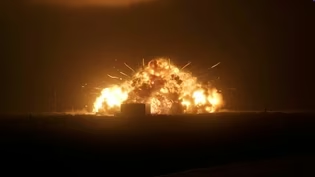
NewBlue Origin rocket explosion could impact NASA moon mission
Video has Closed Captions
How a Blue Origin rocket explosion could impact NASA's moon mission (4m 52s)
 New
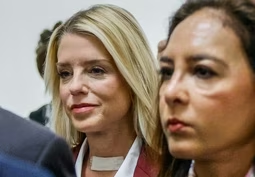
NewBondi defends handling of Epstein investigation
Video has Closed Captions
Bondi defends handling of Epstein investigation but admits 'redaction errors' (5m 39s)
 New
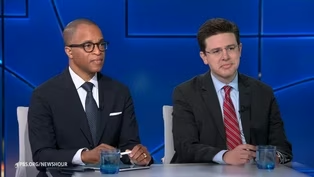
NewCapehart and Continetti on the Texas Senate battle
Video has Closed Captions
Capehart and Continetti on Talarico’s chances against Paxton in Texas (10m 1s)
 New
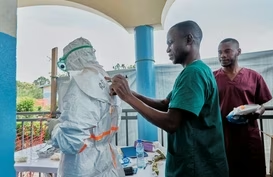
NewKenyan court halts U.S. plan to open Ebola quarantine center
Video has Closed Captions
Kenyan court blocks U.S. plan to open Ebola quarantine center to treat Americans (5m 51s)
 New
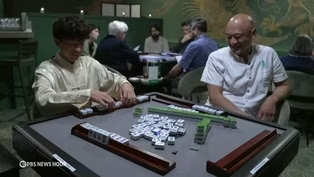
NewMahjong thriving as players embrace community and connection
Video has Closed Captions
Mahjong thriving as players embrace community and connection (5m 50s)
 New
NewNews Wrap: Judge orders Trump's name off Kennedy Center
Video has Closed Captions
News Wrap: Judge orders Kennedy Center to remove Trump's name from building (5m 46s)
 New
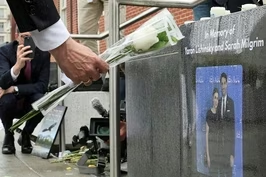
NewSon's murder inspires father to confront rising antisemitism
Video has Closed Captions
Killing of Israeli embassy workers inspires father to confront rising antisemitism (7m 25s)
Providing Support for PBS.org
Learn Moreabout PBS online sponsorship
- News and Public Affairs

Today's top journalists discuss Washington's current political events and public affairs.

- News and Public Affairs

FRONTLINE is investigative journalism that questions, explains and changes our world.
 From My Station







 New Season

Support for PBS provided by:
Major corporate funding for the PBS News Hour is provided by BDO, BNSF, Consumer Cellular, American Cruise Lines, and Raymond James. Funding for the PBS NewsHour Weekend is provided by...